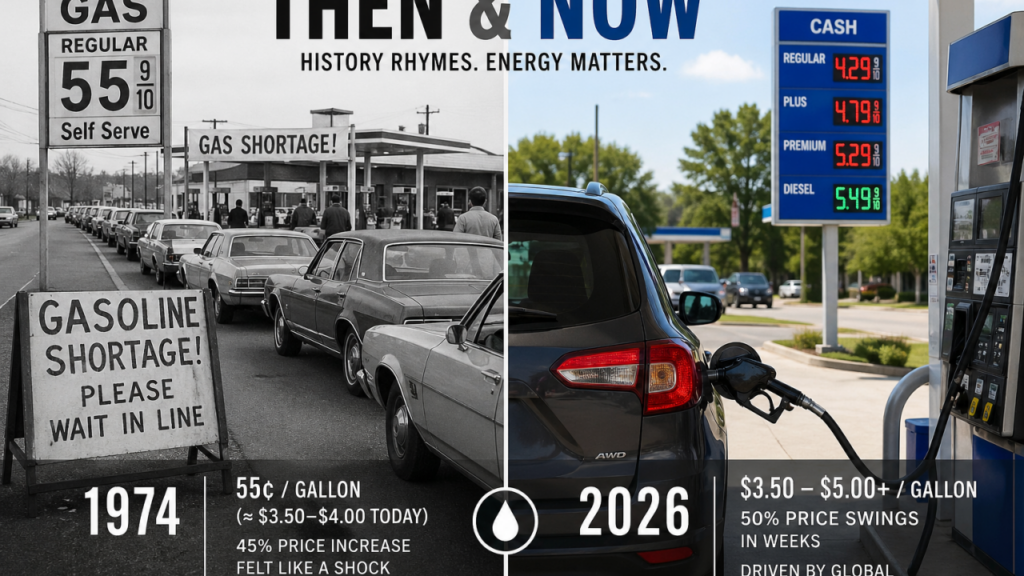
The energy landscape has shifted significantly since I started my career in the oil industry in the 1970s, but the “rhyme” of history is unmistakable. Whether it’s the disco era or the digital age, the core tension between global geopolitics and your local gas station remains.
Let’s look at a simple comparison of the two eras:
The Price Reality: Then vs. Now
- The 1970s: In 1973, drivers paid about 38 cents per gallon. By 1974, it jumped to 55 cents—a 45% increase that felt like a total shock. Adjusted for inflation, that 1974 price is roughly $3.50–$4.00 in today’s money.
- Today (2026): While the nominal price is higher (averaging $3.50–$5.00+ depending on the state), the “shock” comes from the rapid volatility. We’ve seen prices swing by 50% in weeks due to modern supply disruptions.
The Crisis Similarities
- Geopolitical Supply Shocks: Both eras were defined by conflict in the Middle East. The 1973 OPEC embargo and the 1979 Iranian Revolution mirror today’s supply stresses caused by regional conflicts and the closure of critical transit points like the Strait of Hormuz.
- Stagflation Fears: Just like in the 70s, today’s high energy prices are acting as a “tax” on the consumer, driving up the cost of everything from groceries to shipping, leading to fears of persistent inflation coupled with slowing economic growth.
The Political Parallels
- Energy Independence as National Security: In the 70s, the crisis birthed the Strategic Petroleum Reserve (SPR). Today, the American Petroleum Institute (API) notes that the political conversation has returned to this same core theme: “Energy security is national security.”
- The “Blame Game”: Both then and now, politicians often point toward “price gouging” or corporate greed, while industry experts and the API emphasize that prices are a function of global market forces and a lack of long-term investment in domestic infrastructure.
The Big Difference: In the 70s, the U.S. was a massive importer. Today, we are the world’s largest producer. As the API points out, our domestic production acts as a “buffer,” preventing the literal “gas lines” of the 70s even when global prices spike.
The Takeaway
We aren’t in a carbon copy of the 70s, but we are facing the same fundamental truth: The global economy runs on energy. To avoid the mistakes of the past, the focus must remain on stable, long-term energy policies that encourage domestic production and infrastructure.